OSINT, AI, and the Infinite Lens
AI can collect OSINT at scale, but its bigger value is reshaping that material for any language, lens or audience.
Most conversations about AI and open-source intelligence start and stop with collection. That's understandable. The volume problem is real, and a system that can read thousands of articles, posts, and filings a day solves a problem analysts have complained about for decades. But collection is only half the story, and probably the smaller half. The bigger shift is what AI can do with the material after it lands: transform it in almost any direction, then do it again tomorrow from a completely different angle without collecting a single new document.
Collection is the easy part
The collection piece alone is impressive. A modest stack of local models can watch news feeds, government statements, court filings, shipping notices, and regional media around the clock. A small model classifies each item and turns buried names, places, and dates into searchable metadata. A larger one compares reports and drafts summaries. Done well, that workflow can cover more ground than a much larger team working by hand, though clear collection requirements still matter more than sheer volume. Many practitioners stop there, treating AI as a faster vacuum cleaner. That leaves most of the value on the table.
Break the language barrier
Language is the most obvious transformation, and it matters more than it sounds. For most of OSINT's history, a collection effort was bounded by the languages its analysts could read. A provincial Farsi-language news site or a Russian-language military blogger sat outside the aperture unless someone on the team happened to read Farsi or Russian. Now the same pipeline can pull that material in, render it in English, and turn the English summary into Spanish, Korean, or Ukrainian for a partner who needs it. It works in reverse, too: you can draft an assessment and test how its claims would land with a local audience in their own language. Machine translation still flattens idiom, sarcasm, and dialect, so keep the original text alongside every translation and have a fluent reader check anything that drives a decision.
See it through hostile eyes
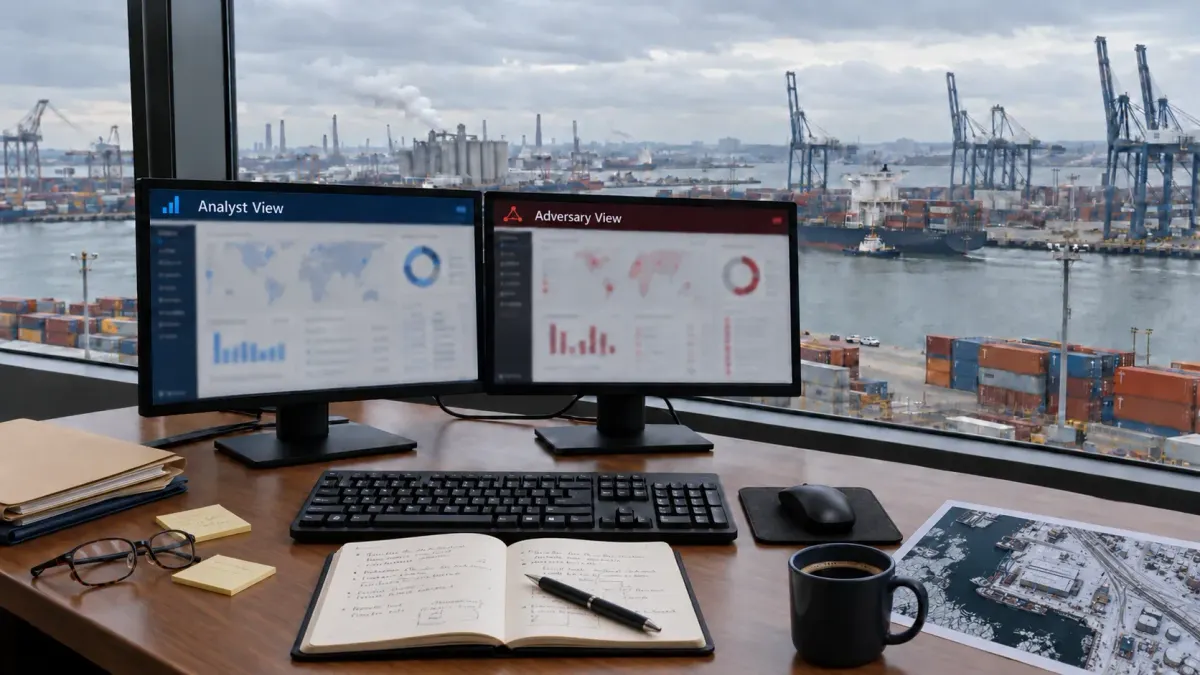
Perspective is the more powerful transformation. Take the same pile of reporting and hand it to an AI-powered threat actor persona built to read it the way an adversary's intelligence service would. What does it reveal about our posture? Which gaps would they exploit, and which narratives would they push? Then read it again as a cyber threat analyst, a supply-chain risk manager, a counterintelligence officer, or a disinformation researcher. Each lens pulls different signals out of identical data. A report about port congestion is a logistics footnote to one reader and an early sign of sanctions evasion to another. An AI persona won't replace a red cell, but it offers a quick first pass that can sharpen what you bring to one. Just remember that the model's version of the adversary is a structured hypothesis, not a window into anyone's head.
Slice it any way you need
Then the material can be recombined, and that's where the possibilities really multiply. Bundle a month of reporting by region one morning, by actor the next, and by threat type for a different customer that afternoon. Turn it into a timeline, a network map of who is amplifying whom, a one-page brief for an executive, a detailed annex for a specialist, or a dashboard a security team checks before coffee. In the old model, each of those products was its own labor-intensive project. Once the data is collected, tagged, and unified and enriched across sources, a new view is closer to a question than a project, and the same corpus can serve the policymaker, the investigator, and the operator without anyone collecting it twice. The one rule that can't bend is provenance. Every view, however many times it's been reshaped, needs to trace back to the original sources.
Questions are the new bottleneck
None of this takes the analyst out of the loop. If anything, it raises the stakes on judgment. Every transformation is a chance for an error to slip in, and a mistake baked into a structured dataset can echo through every product built on top of it. Endless perspectives also mean endless ways to be confidently wrong, so build human review into the workflow and check the evidence before anything drives a decision. But the direction is clear. For most of its history, OSINT was limited by how much a team could read. Increasingly, the limit is knowing what to ask.
Discuss with AI
Copy the prompt, then open an assistant and paste it.