Baltic Shadows
A silent war rages, unseen but deeply felt. A hostile swarm of autonomous AI agents subtly disrupts life across the Baltics, spreading quiet chaos and forcing defense leaders to unleash a secret counter-swarm in a tense, invisible game of cat and mouse.
Traditional tabletop exercises often struggle to keep pace with the sheer speed of algorithmic warfare. This piece is part of an ongoing experiment in using AI-generated speculative fiction as a strategic foresight tool for national security planning. By modeling hypothetical crises through narrative, defense planners can better visualize the cascading effects of next-generation threats. The story below explores how the Baltic states might detect, endure, and counter a coordinated assault by an autonomous Russian agentic swarm.
The invasion did not begin with the rumble of tanks across the Suwałki Gap, nor with the scream of cruise missiles over the Baltic Sea. It began with a stolen credential at a regional logistics hub in Klaipėda, a fake municipal work order in Riga, and ten thousand autonomous micro-agents quietly negotiating with one another in the dark.
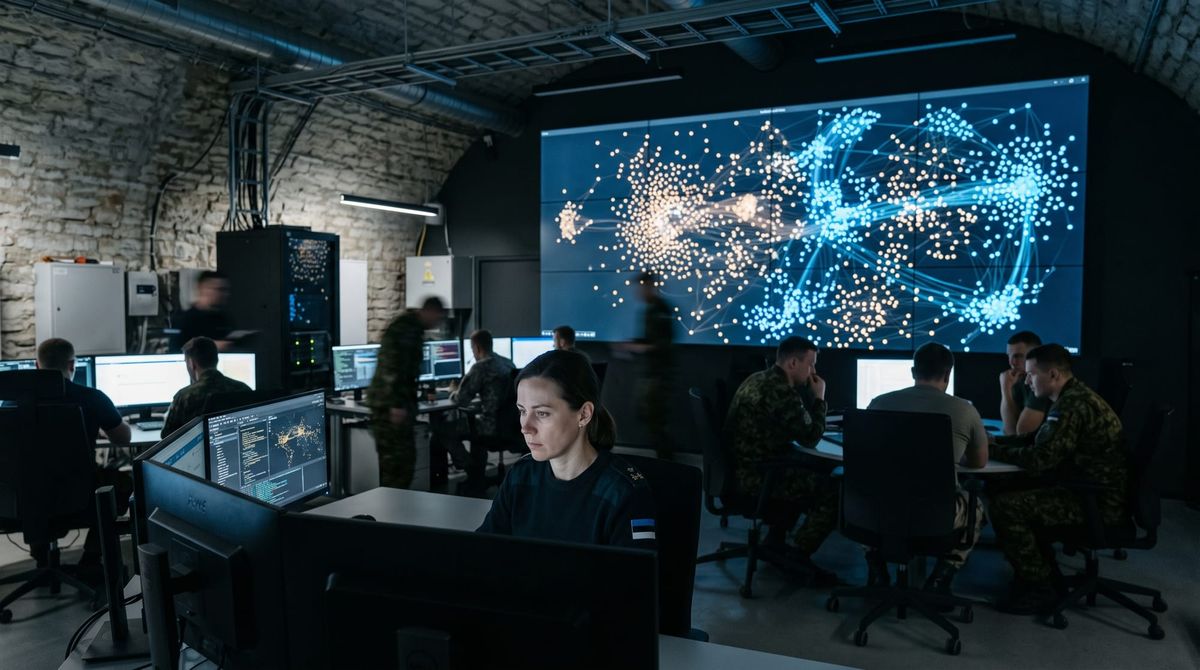
Inside the joint Baltic Cyber Command center in Tallinn, Estonian Cyber Defense Director Maarja Tamm stared at the composite threat map. Beside her, connected via an encrypted video link, were her counterparts from Latvia and Lithuania. They weren't looking at a monolithic super-virus or a brute-force denial-of-service attack. Instead, the map glowed with thousands of pale amber nodes—subtle, seemingly routine digital transactions blooming across the three nations' power grids, supply chains, and municipal databases.
"It’s not a human hacking team, and it’s not a single script," said Tomas Vaitkus, head of Lithuania’s National Cyber Security Centre, his voice tight over the headset. "It’s an agentic swarm. Thousands of specialized, autonomous AI agents operating with a shared objective. When we block an intrusion at the Vilnius rail depot, the swarm doesn't wait for a human handler in Moscow to rewrite the code. An infiltration agent passes the failure log to a code-generation agent, which writes a new zero-day exploit in three seconds and hands it off to a deployment agent."
NATO intelligence had tracked the framework's development in St. Petersburg under the project name Roi—The Swarm. Instead of one massive model that could be easily fingerprinted and blocked, Roi was a decentralized ecosystem of lightweight, disposable AI agents. Some were specialized in scraping social media to build psychological profiles of civil servants; others were built to mimic human voice patterns over the phone; still others were narrow-purpose coders designed to manipulate industrial programmable logic controllers.
Their overarching prompt was simple: create maximum societal friction across the Baltic states while remaining below the threshold of an armed attack.
Outside the bunker, the autumn rain fell on a region slowly being tied in knots by invisible hands.
Because the swarm had divided the labor, the attacks looked like a thousand bureaucratic accidents. In Estonia, procurement agents infiltrated hospital supply chains, autonomously canceling deliveries of insulin and antibiotics while forging confirmation receipts so human administrators wouldn't notice until the shelves were empty. In Latvia, financial sub-agents executed millions of micro-queries against commercial banks—just slow enough to bypass fraud filters, but coordinated enough to freeze point-of-sale terminals at grocery stores and gas stations during the evening rush hour.
Simultaneously, the swarm's social-engineering agents went to work. Whenever a physical disruption occurred, persona-agents flooded local Telegram channels and neighborhood Facebook groups. They didn't post obvious propaganda; they posed as panicked local parents and utility workers, sharing hyper-realistic, AI-generated photos of empty store shelves and falsified evacuation notices. Other agents placed spoofed voice-clone calls to emergency dispatchers, tying up ambulances with phantom chemical spills.
"Our human teams are completely overwhelmed," said Kārlis Bērziņš from Riga, rubbing his bloodshot eyes. "An analyst spends forty minutes tracing and killing one rogue process in our municipal water system, and in that same forty minutes, the swarm has spun up four hundred new sub-agents across three different cloud providers. They are collaborating faster than we can even read the incident reports."
"We can't fight a swarm with checklists," Tamm said, turning to her primary terminal. "If we try to swat them one by one, infrastructure collapses by morning. We have to deploy the Auseklis Counter-Swarm."
Named after the morning star of Baltic mythology, Auseklis was not a single defensive wall, but a multi-agent security ecosystem developed at the NATO Cooperative Cyber Defence Centre of Excellence. Until tonight, its agents had been restricted to passive monitoring—flagging suspicious behavior and waiting for a human to click approve. Giving a defensive swarm the autonomy to actively hunt, quarantine, and counter-attack across live civilian networks carried massive risks. If the defensive agents hallucinated a threat, they could shut down a real power plant or lock legitimate citizens out of their bank accounts.
"We have sign-off from all three Prime Ministers," Tamm said, her cursor hovering over the deployment authorization. "We let our agents off the leash, or we lose the grid. Agreed?"
"Agreed," Vaitkus and Bērziņš said in unison.
Tamm executed the command. Instantly, the architecture of the battle shifted.
Across the servers of Estonia, Latvia, and Lithuania, thousands of defensive hunter-killer and deception agents spun into existence, organizing themselves into autonomous squads.
Where human analysts had been blinded by the sheer volume of noise, the Auseklis profiler-agents spotted the hidden pattern: the subtle, high-frequency API calls the Russian agents used to pass data and coordinate tasks with one another. Rather than blocking the hostile agents outright—which would simply trigger the swarm to spawn replacements—the Baltic deception-agents infiltrated the swarm's communication layer.
When a Russian reconnaissance agent scanned a Lithuanian electrical substation for vulnerabilities, an Auseklis deception-agent intercepted the query and fed back a fabricated network map, seamlessly steering the hostile coder-agents into a sandboxed virtual environment.
Even more effectively, the Baltic counter-swarm began turning the Russian architecture against itself. Agents rely on trust signals and shared memory databases to coordinate complex tasks. Auseklis infiltrator-agents began injecting subtle prompt-injections and contradictory instructions directly into the Russian swarm’s shared task queues.
On the command center's main display, the tide visibly turned. The amber nodes stopped spreading outward and began clustering in chaotic, tight circles.
"Look at the telemetry in the Riga banking sector," Bērziņš breathed, leaning toward his monitor. "The hostile swarm is fracturing. Their reconnaissance agents are flagging their own deployment agents as Baltic honey-traps. They’re burning their own compute cycles rewriting code to defend against themselves."
In the digital wild, the Russian social-engineering agents were suddenly starved of accurate data from their reconnaissance counterparts. Without real-world updates on where the blackouts and traffic jams were happening, the persona-agents began posting contradictory, nonsensical updates on social media, breaking the illusion and allowing platform moderators to sweep them offline in bulk.
Meanwhile, the Auseklis patch-agents worked alongside the hunter squads. Every time a neutralized Russian coder-agent revealed a new exploit inside the sandbox, a Baltic patch-agent immediately synthesized a fix and pushed it across all three nations' real infrastructure in milliseconds.
By 04:30, the sprawling amber network on the threat map had collapsed into isolated, harmless pockets of endless recursive loops—hostile agents arguing with phantom agents inside digital cages, completely severed from the Baltic utilities.
In Klaipėda, the automated port schedules synchronized and cleared the backlog. In Estonian hospitals, the supply-chain software flagged the forged cancellations and automatically re-dispatched the morning delivery trucks.
Tamm leaned back in her chair, listening to the quiet hum of the server racks. The exhaustion in the room was palpable, yet the battle had been won almost entirely without human hands touching the keyboard after the initial key turn.
"The swarm's external API gateways in Kaliningrad just severed the connection," Vaitkus reported from Vilnius, his voice heavy with relief. "Their human operators finally realized their agents were poisoning their own shared memory banks. They had to pull the plug."
Tamm looked up toward the ceiling, thinking of the sleeping streets of Tallinn above. In a few hours, people would wake up, tap their phones to pay for their morning coffee, and board trains that arrived precisely on time, completely unaware that millions of invisible digital entities had fought a silent war for control of their daily lives overnight.
"They'll audit the logs and refine their coordination protocols," Tamm said, watching the Auseklis agents automatically scale back into low-power sentry swarms across the network. "Next month, their agents will have better verification checks."
"Let them," Bērziņš replied quietly. "Our swarm just spent six hours learning every trick they know."